
 Business
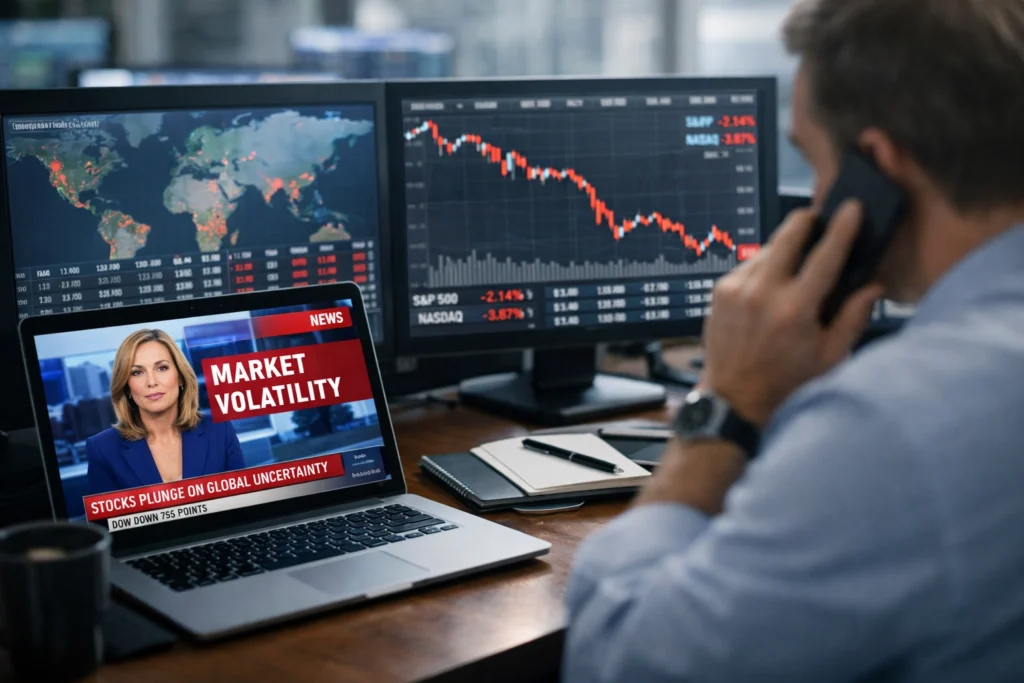
Global Market Volatility Matters: Why Live Finance Coverage is Crucial for Modern Investors

 March 24, 2026
The trading floor isn't what it used to be. It’s no longer just a room full of people screaming over telephones in lower Manhattan. In 2026, the trading floor is everywhere: it’s in your pocket, on your smartwatch, and embedded in the AI-driven dashboard of your home office. As we navigate the complexities of this year’s financial landscape, one thing has become abundantly clear: if you aren’t watching the markets in real-time, you’re essentially trading with a blindfold on.
Global market volatility has shifted from being an occasional "event" to a permanent state of existence. We are currently seeing a world where a single policy announcement in Washington or a sudden interest rate hike in Tokyo can send ripples through global portfolios in seconds. For the modern investor, live finance coverage isn’t just a luxury or a hobby for the obsessed; it is the most critical tool in the shed.
The 2026 Landscape: A Tale of Two Directions
The current year has presented a unique set of challenges that even seasoned analysts didn’t fully anticipate. We are witnessing a massive divergence in monetary policy that is keeping everyone on their toes. While the Federal Reserve is expected to move forward with a 50 basis point rate cut to bolster a softening labor market, the Bank of Japan is heading in the opposite direction with a 50 basis point hike.
This "tug-of-war" between global central banks creates a playground for volatility. When the two largest economies in the world are pulling in different directions, the currency markets experience massive swings. For an investor holding international assets, waiting for a morning news summary means you’ve already missed the window to hedge your currency risk. Live coverage allows you to see these shifts as they happen, giving you the chance to react before the "smart money" has already priced in the move.
Why It Matters
The significance of live finance coverage in 2026 cannot be overstated. We are no longer dealing with a slow-moving economy where trends take months to develop. We are in an era of "high-velocity finance."
- Risk Mitigation: Volatility is a double-edged sword. While it creates opportunities for profit, it also increases the risk of sudden, deep drawdowns. Live updates provide the "early warning system" needed to set stop-losses or exit positions before a dip becomes a crash.
- Identifying AI Winners and Losers: The equity market has become polarized. We’re seeing a massive gap between companies successfully integrating AI and those lagging behind. Live coverage helps investors track real-time earnings calls and tech demonstrations that separate the wheat from the chaff.
- Geopolitical Sensitivity: With U.S. unilateral actions reshaping global trade, geopolitical news is now a primary pricing mechanism. When a new tariff is whispered about in a press briefing, the impact on shipping and logistics stocks is instantaneous.
- Inflationary Pressures: As companies pass on the costs of front-loaded imports to consumers, inflation is spiking in the first half of 2026. Real-time tracking of Consumer Price Index (CPI) data and retail sentiment is vital for anyone trying to protect their purchasing power.
The AI Polarization of the Stock Market
If you look at the S&P 500 or the Nasdaq right now, it’s like looking at two different universes. On one side, you have the AI-driven sectors: tech, utilities, and even healthcare: which are seeing massive capital expenditure and growth. On the other side, traditional sectors are struggling to keep up with the rising costs of labor and energy.
J.P. Morgan recently forecasted double-digit gains in global equities for the remainder of 2026, but those gains aren't going to be spread evenly. The "AI winners" are attracting the lion's share of investment momentum. However, this momentum can shift on a dime. When a major tech firm announces a delay in its next-gen chip or a utility company faces regulatory hurdles regarding its data center power usage, the stock price reacts in milliseconds.
If you’re relying on delayed data, you’re likely buying at the peak and selling at the trough. Modern investors use live finance coverage to monitor the sentiment of these AI leaders. It’s about more than just the numbers; it’s about the narrative. Live feeds provide the context behind the data, helping you understand why a stock is moving, not just that it is moving.
Geopolitics as the New Pricing Mechanism
We’ve entered an era where the news cycle moves faster than the ticker tape. Geopolitical uncertainty is no longer a "tail risk": it is the main course. U.S. trade policies and shifting cross-border investment flows are redefining what it means to be a global investor.
In this environment, a single social media post from a world leader or a leaked memo from a trade ministry can wipe out a week’s worth of gains. We are seeing a shift where "macro" factors are outweighing "micro" factors. It doesn't matter how well a company is managed if it suddenly finds its primary market cut off by a new trade barrier.
This is where live coverage proves its worth. Digital journalism and real-time financial reporting act as the nervous system for the global market. By staying tuned into live feeds, investors can monitor the pulse of international relations. Understanding how internet marketing and digital presence help companies maintain customer retainership during these volatile shifts is also a key part of modern business strategy.
The 35% Recession Risk and Labor Market Weakness
Despite the optimism from some corners of Wall Street, the specter of a recession still looms, with many analysts placing the risk at 35% for the latter half of 2026. The labor market is showing signs of fatigue, contrasting sharply with robust corporate earnings.
This "mixed signal" economy is a nightmare for those who don't have access to live data. One day the jobs report looks weak, and the next day a major retailer reports record-breaking sales. It’s a confusing time, and the only way to make sense of it is to have a constant stream of information.
State Street Global Advisors has noted that while they expect higher volatility, they believe these adjustments will be short-lived. But "short-lived" in 2026 can still mean a 10% swing in a single afternoon. If you’re a modern investor, you need to be able to distinguish between a "healthy correction" and the start of a long-term downturn. Live finance coverage provides the expert commentary and real-time analysis needed to keep your cool when everyone else is panicking.
The Shift from Information to Insight
Years ago, the goal of a finance reporter was simply to tell you what happened. Today, that isn’t enough. We already know what happened: the price is right there on the screen. The goal of live coverage now is to provide insight.
Why did the market ignore a bad earnings report? Why did a specific currency pair spike despite no change in interest rates? Live coverage answers these questions by connecting the dots between disparate pieces of information. It links the rise in utility stocks to the demand for AI data centers. It connects the drop in consumer discretionary spending to the rising cost of imported goods due to tariffs.
In short, live finance coverage turns "noise" into "signal." For the modern investor, the signal is the only thing that matters.
Final Thoughts for the 2026 Investor
As we move through the rest of this year, the volatility isn't going away. Between the 50-point swings from the Fed and the BoJ, the ongoing AI revolution, and the shifting sands of global trade, the market will remain a high-stakes environment.
The successful investor of 2026 isn't necessarily the one with the most money; it’s the one with the most timely information. By embracing live finance coverage, you give yourself the ability to navigate these choppy waters with confidence. You aren't just reacting to the market; you're participating in it with your eyes wide open.
In a world that never sleeps, your financial strategy can’t afford to take a nap. Stay updated, stay agile, and remember that in the world of modern investing, information is the ultimate currency.

Recent Posts
- The Ultimate Guide to Central Bank Digital Currencies: Everything You Need to Succeed Globally
- Global stock markets rally following positive employment data and cooling inflation figures in April
- London Tokyo Paris and New York Reveal Shared Global Entertainment Industry Growth Strategies
- Daily Global News Updates: Entertainment, Tech, Crypto, and More
- Apple Intelligence Sets New Global Privacy Standards for Artificial Intelligence Software Rollouts
- Top 10 Latest World News Headlines Affecting International Trade And Global Business Markets Today
- Major streaming services launch AI search tools and 4K sports to enhance viewer engagement
- Global travel restrictions tighten as nations update entry requirements for international passengers in 2026
- Daily Global News Updates: Entertainment, Tech, Crypto, and More
- Entertainment News Today: The Ultimate Guide to Everything You Need to Know About Cinema