
 Business
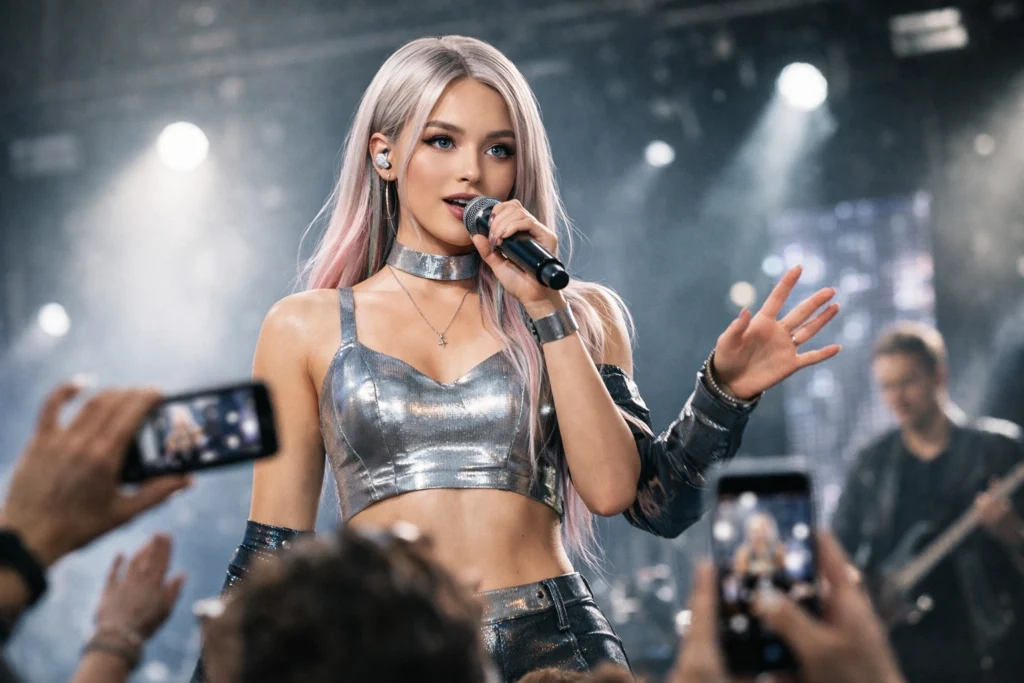
Why Everyone Is Talking About AI-Generated Pop Stars (And You Should Too)

 March 22, 2026
It’s March 2026, and if you haven’t yet found yourself humming along to a song performed by an artist who literally doesn't exist, you’re probably living under a rock. Or maybe you just haven't realized that the "new indie darling" you’ve been streaming is actually a collection of algorithms housed on a server in Silicon Valley.
The music industry is currently going through its biggest shake-up since the invention of the MP3, and it’s all thanks to AI-generated pop stars. We’re not just talking about robots making beeps and boops; we’re talking about digital entities with complex backstories, "authentic" personalities, and voices that can hit notes no human larynx could ever dream of reaching.
Whether you're a die-hard music fan, a tech geek, or just someone trying to keep up with the marketing trends of 2026, here is why AI pop stars are dominating the conversation and why they are here to stay.
The Death of the Gatekeeper
For decades, if you wanted to become a pop star, you had to play the game. You needed a talent scout, a record label, a massive marketing budget, and, most importantly, the luck of the draw. But in 2026, the barrier to entry has completely evaporated.
The technology to create a fully-fledged pop star is now sitting on your laptop. Consumer-friendly AI tools have become so sophisticated that anyone with a vision can design a custom voice, generate high-fidelity original tracks, and even render 4K music videos. We’ve seen a massive shift where independent creators are launching "virtual acts" that compete directly with major label artists on Spotify and TikTok.
This democratization means we’re seeing a surge in creative diversity. We aren't just getting what a few executives think will sell; we're getting what the digital community wants to hear. If you want to know how this same tech is disrupting other industries, check out our beginners guide to AI in Hollywood.
Virtual Idols are Drawing Real Audiences
If you think people won’t pay real money to see a digital projection, think again. Virtual idols have moved far beyond the "novelty" phase.
Take Hatsune Miku, for example. The virtual Japanese singer has been selling out stadiums for years, but in 2026, the tech has caught up to the hype globally. We’re seeing virtual performers headline major festivals like Coachella and Glastonbury. But it’s not just purely digital avatars. Even established human artists are getting in on the action.
Techno legend Reinier Zonneveld recently blew minds by performing a back-to-back set with an AI clone of himself. This "AI Reinier" was trained on 2,000 hours of his music and 1,000 of his past live shows. It wasn't just playing a recording; it was improvising live techno in real-time, reacting to the crowd and the human Reinier.
When the lines between human performance and algorithmic improvisation blur that much, the audience stops caring about "real" versus "fake" and starts focusing on the experience.
The Commercial Stakes are Sky-High
The money moving into AI music is staggering. Industry analysts are predicting that by the end of 2026, we will see the first AI-generated song reach number one on the Billboard Hot 100. This isn't just a gimmick anymore; it’s a gold mine.
Major established artists are no longer fighting the "machine", they’re licensing it. Stars like Charli XCX, Demi Lovato, and John Legend have already pioneered the practice of allowing their voices to be used for AI applications. Imagine being able to "hire" John Legend to sing a personalized birthday song for your mom, or Charli XCX to feature on your indie track for a flat licensing fee.
This creates a new revenue stream for artists that doesn't require them to spend 18 hours in a recording studio. It’s the ultimate passive income. While some traditional artists, like Becoming Young, continue to focus on soul-stirring human emotion, many others are finding that the hybrid model is the only way to scale in a 2026 market.
The Celebrity Landscape Is Fragmenting
The way we define "celebrity" is changing forever. In the past, a star was a single human being who you followed on social media. By 2030, experts predict that the biggest celebrities in the world will likely be "AI-human hybrids."
We are moving into an era of "fragmented fame." You might have an AI pop star who exists purely as a voice on a streaming app, a 3D model on a VR platform, and a chatbot on your phone that you can text at 2 AM. This level of accessibility is something a human celebrity could never provide. A human star needs to sleep, eat, and occasionally hide from the paparazzi. An AI star is "on" 24/7, engaging with millions of fans individually and simultaneously.
Why It Matters
So, why should you care? Beyond the cool factor, this shift represents a fundamental change in how we consume culture.
- Infinite Content: We are entering a period of "supply shock." There is now an infinite amount of music being created. This makes the role of the "tastemaker" or the "curator" more important than ever.
- The Ethics of Authenticity: As AI voices become indistinguishable from humans, we have to grapple with what "art" really is. Does it matter if a song about heartbreak was written by a computer that has never felt pain? For most Gen Z and Gen Alpha listeners, the answer seems to be a resounding "no": as long as the song hits right.
- Marketing Evolution: For brands and marketing agencies (like us here at Clout News), AI pop stars offer a dream scenario. You can build a brand ambassador from scratch that perfectly aligns with your values, never gets caught in a scandal, and can speak any language fluently to reach a global audience instantly.
The "Supply Shock": Will Humans Survive?
There is a legitimate fear that AI music will flood the market to the point where human artists can't be heard. We’re already seeing thousands of AI-generated tracks uploaded to streaming services every hour.
However, history shows that whenever a new technology makes creation easier, the value of "humanity" actually goes up. Just as the invention of the camera didn't kill painting: it just pushed painting to become more abstract and expressive: AI music is forcing human artists to be more creative, more raw, and more "real" than ever before.
The pop stars of the future aren't just going to be lines of code, and they aren't just going to be people with microphones. They’re going to be a mix of both. We are entering the era of the Cyborg Pop Star, and honestly, the soundtrack is pretty great.
Final Thoughts
The rise of AI-generated pop stars isn't a sign that music is dying; it’s a sign that music is evolving. We are moving toward a world where the creator's imagination is the only limit, and where the "artist" is a collaborative effort between human intuition and machine precision.
Whether you love it or hate it, you can't ignore it. The next time you’re vibing to a new track on your "Discovery Weekly" playlist, take a second to wonder: is there a heart beating behind those vocals, or just a very, very smart processor? Either way, if it makes you dance, does it really matter?
Stay tuned to Clout News as we continue to track the intersection of tech, entertainment, and the future of digital culture. The world is changing fast( don't get left behind in the analog age.)

Recent Posts
- The Ultimate Guide to Central Bank Digital Currencies: Everything You Need to Succeed Globally
- Global stock markets rally following positive employment data and cooling inflation figures in April
- London Tokyo Paris and New York Reveal Shared Global Entertainment Industry Growth Strategies
- Daily Global News Updates: Entertainment, Tech, Crypto, and More
- Apple Intelligence Sets New Global Privacy Standards for Artificial Intelligence Software Rollouts
- Top 10 Latest World News Headlines Affecting International Trade And Global Business Markets Today
- Major streaming services launch AI search tools and 4K sports to enhance viewer engagement
- Global travel restrictions tighten as nations update entry requirements for international passengers in 2026
- Daily Global News Updates: Entertainment, Tech, Crypto, and More
- Entertainment News Today: The Ultimate Guide to Everything You Need to Know About Cinema